
Shopify vs WooCommerce for
Small Businesses —
Honest 2026 Verdict
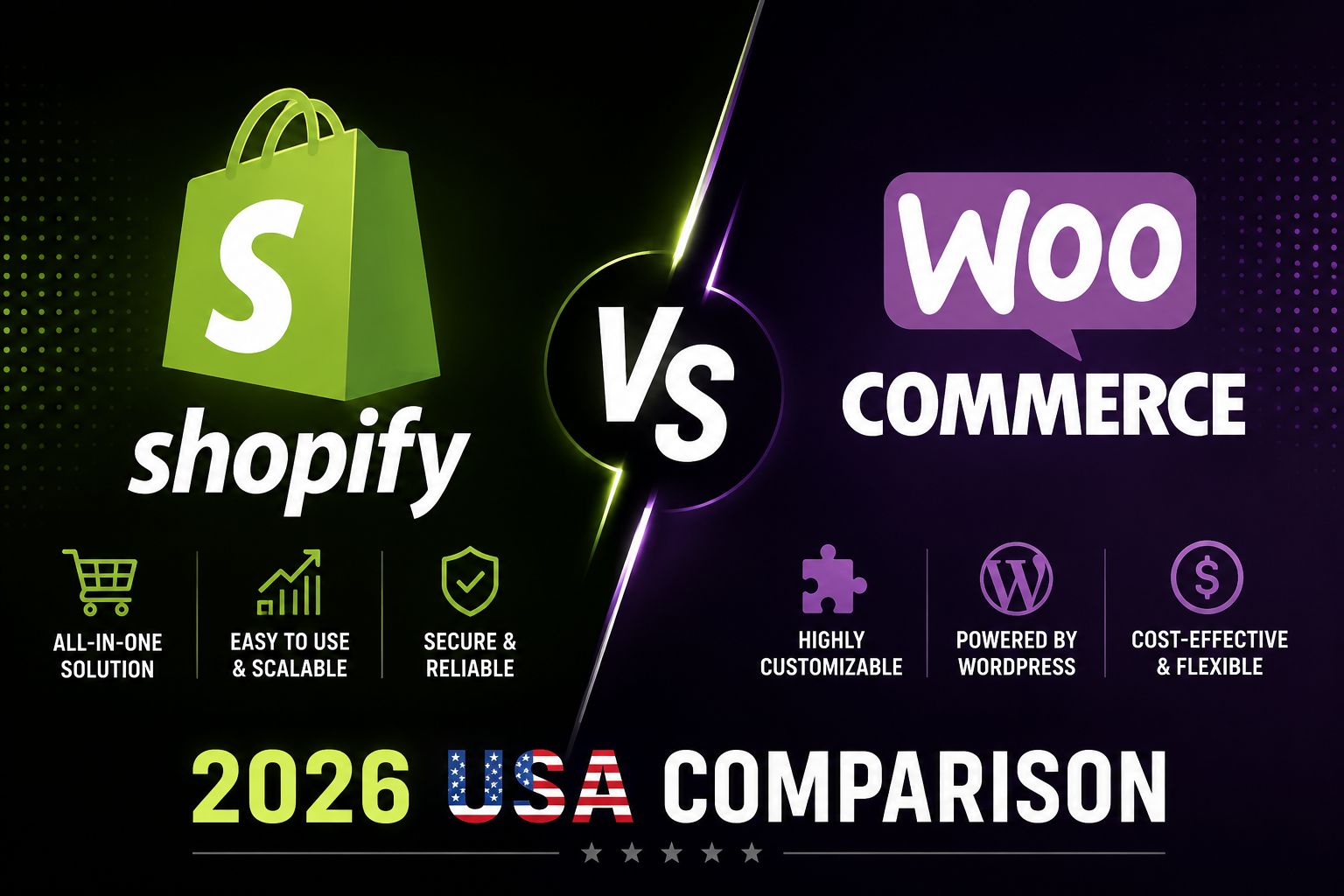
The Shopify vs WooCommerce debate is the most common question US small business owners ask before choosing an ecommerce platform. This guide compares every factor that matters — pricing, SEO, ease of use, payment fees, ownership, and long-term cost — with real 2026 numbers so you can make the right call without overpaying.
Quick Verdict — Shopify vs WooCommerce for Small Businesses
Before we dive into the detail, here is the honest headline for US small business owners in 2026: WooCommerce wins for most USA small businesses on pricing, SEO, ownership, and long-term value. Shopify wins on ease of setup and 24/7 customer support. Neither platform is universally better — the right choice depends on your specific situation, which is what this guide helps you determine.
According to BuiltWith’s 2026 data, WooCommerce powers 36% of all online stores compared to Shopify’s 23% — and WooCommerce’s lead is growing specifically in the US small business segment. Here is why in detail.
Shopify vs WooCommerce Pricing for Small Businesses — Real 3-Year Costs
Pricing is where the Shopify vs WooCommerce debate is most misunderstood by US small business owners. Shopify appears affordable at $29/month — until you do the math over 3 years and add the apps most US stores need.
Shopify pricing for small businesses in 2026
Shopify charges a mandatory monthly subscription with three core tiers. For a USA small business:
- Basic Shopify — $29/month ($348/year). Limited reports, 2 staff accounts, 2% transaction fee if not using Shopify Payments.
- Shopify — $79/month ($948/year). Professional reports, 5 staff accounts, 1% transaction fee if not using Shopify Payments.
- Advanced Shopify — $299/month ($3,588/year). Advanced reports, 15 staff accounts, 0.5% transaction fee.
- Shopify apps — most US stores need $50–$200/month in third-party apps for features WooCommerce includes free (email marketing, reviews, advanced SEO, loyalty programs, subscriptions).
- Shopify theme — premium themes cost $180–$350 one-time. Free themes are limited.
WooCommerce pricing for small businesses in 2026
- WooCommerce core — $0. Always free, open-source software.
- Hosting — $35–$120/year (SiteGround, Bluehost) or $240–$600/year (WP Engine managed).
- Domain — $12–$15/year.
- Theme — $0 with free Blocksy or Astra theme (both excellent for WooCommerce).
- Essential plugins — $0–$150/year. RankMath (SEO), Wordfence (security), UpdraftPlus (backups) are all free. WP Rocket for speed is $59/year.
- Total WooCommerce annual cost — $100–$400/year for most USA small business stores.
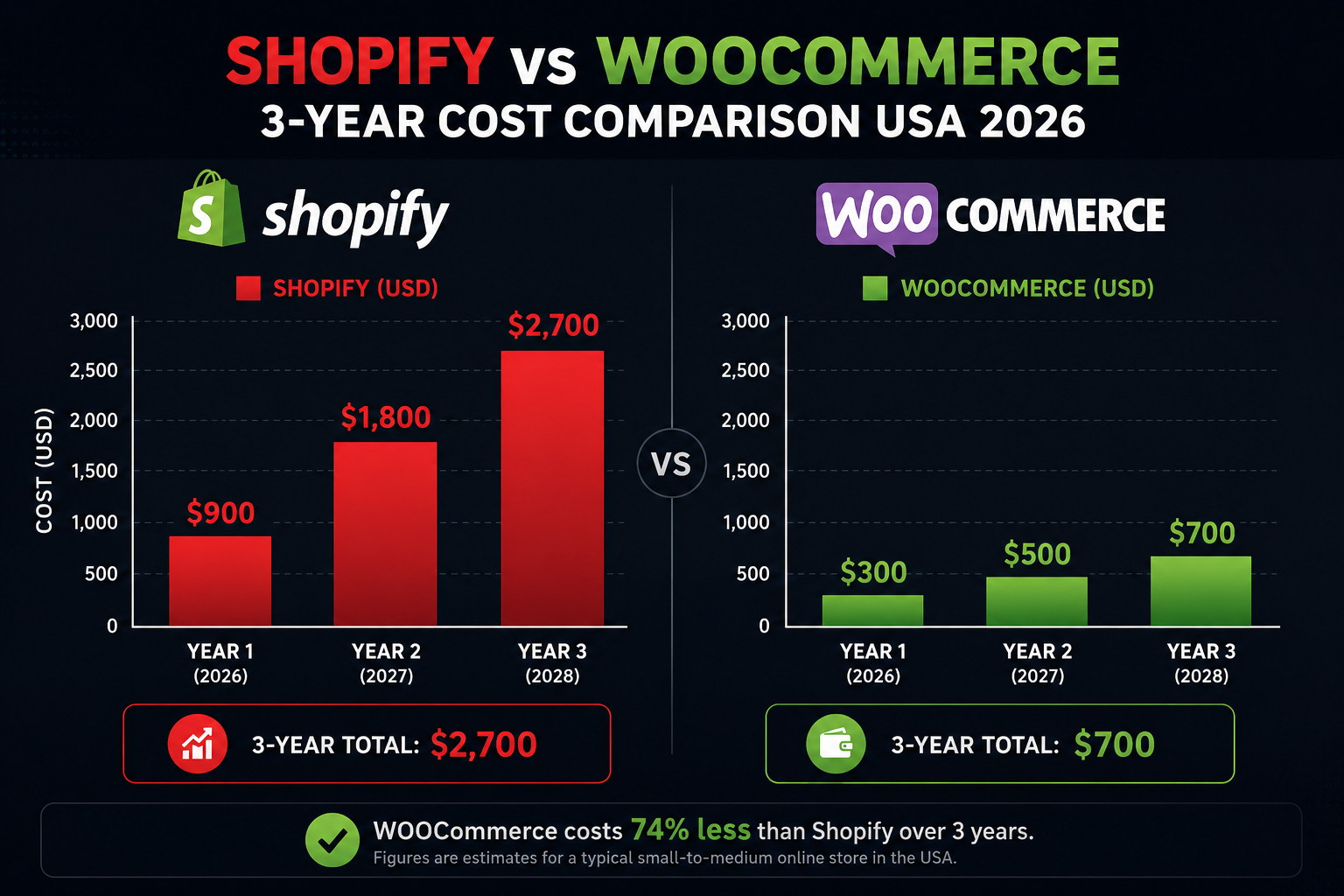
Over 3 years, a USA small business on Shopify Basic pays $1,044 in platform fees alone — before apps, themes, or transaction fees. The same store on WooCommerce pays $300–$600 for hosting and domain. The difference ($444–$744) funds an entire professional WooCommerce redesign from CodePulse Studios. This is money most US small businesses are quietly losing every year.
Pricing winner: WooCommerce — dramatically cheaper for USA small businesses over any time period longer than 6 months.
Shopify vs WooCommerce SEO — Which Ranks Better on Google USA
SEO is the most important long-term factor for any USA online store — because the business that ranks #1 on Google for its product keywords gets free, compounding traffic forever. The Shopify vs WooCommerce SEO comparison is not close in 2026.
Why WooCommerce wins the SEO comparison for USA stores
- Full technical SEO control — with RankMath (free), you control every title tag, meta description, schema markup type, canonical URL, and Open Graph tag on every product page. Shopify’s SEO controls are limited and some fields are locked by the platform.
- Schema markup — WooCommerce lets you add Product, Review, BreadcrumbList, and LocalBusiness schema automatically via RankMath. Google uses schema to show star ratings and prices directly in search results — a major click-through boost. Shopify’s schema is limited and requires paid apps to customize.
- URL structure — WooCommerce lets you set any URL structure (e.g. yourstore.com/product-name). Shopify forces /products/ in all product URLs and /collections/ in category URLs — this creates longer, less clean URLs that rank slightly worse for competitive keywords.
- Page speed — WooCommerce with WP Rocket and Smush consistently achieves 90+ PageSpeed scores. Google uses Core Web Vitals as a ranking factor. Shopify’s speed varies by theme and is harder to optimize precisely.
- Blog SEO — WordPress is the world’s best blogging platform. A WooCommerce store with a WordPress blog can target hundreds of buying-intent content keywords that drive free traffic to products. Shopify’s blog is basic and lacks many SEO controls WordPress offers.
Multiple independent studies — including analysis by Ahrefs and Moz — consistently confirm WordPress/WooCommerce sites outrank Shopify stores for competitive US product keywords when given the same backlink profile. The SEO advantage compounds over time. For more on optimizing your WooCommerce store for Google, see our guide to the best WordPress plugins for USA small businesses.
SEO winner: WooCommerce — by a significant margin for USA stores targeting Google rankings.
Shopify vs WooCommerce Ease of Use for USA Business Owners
This is the one area where Shopify wins the comparison clearly — and it is worth being honest about. Shopify is genuinely easier to use than WooCommerce for US business owners who want to set up and manage their own store without any developer help.
Why Shopify is easier for USA beginners
Shopify is a fully hosted platform — you do not manage hosting, updates, backups, or security. The admin interface is clean, consistent, and beginner-friendly. Adding products, creating discount codes, and processing orders all take minutes. Shopify’s 24/7 live chat support means you can get help at 2am if something breaks.
Why WooCommerce ease of use is not a problem with the right setup
The “WooCommerce is too complicated” concern applies to setting it up — not to running it day-to-day. Once a professional has set up your WooCommerce store correctly, the day-to-day tasks — adding products, processing orders, running sales, updating content — are just as simple as Shopify. At CodePulse Studios, every WooCommerce build we deliver to USA clients includes a full training session covering exactly how to manage the store independently.
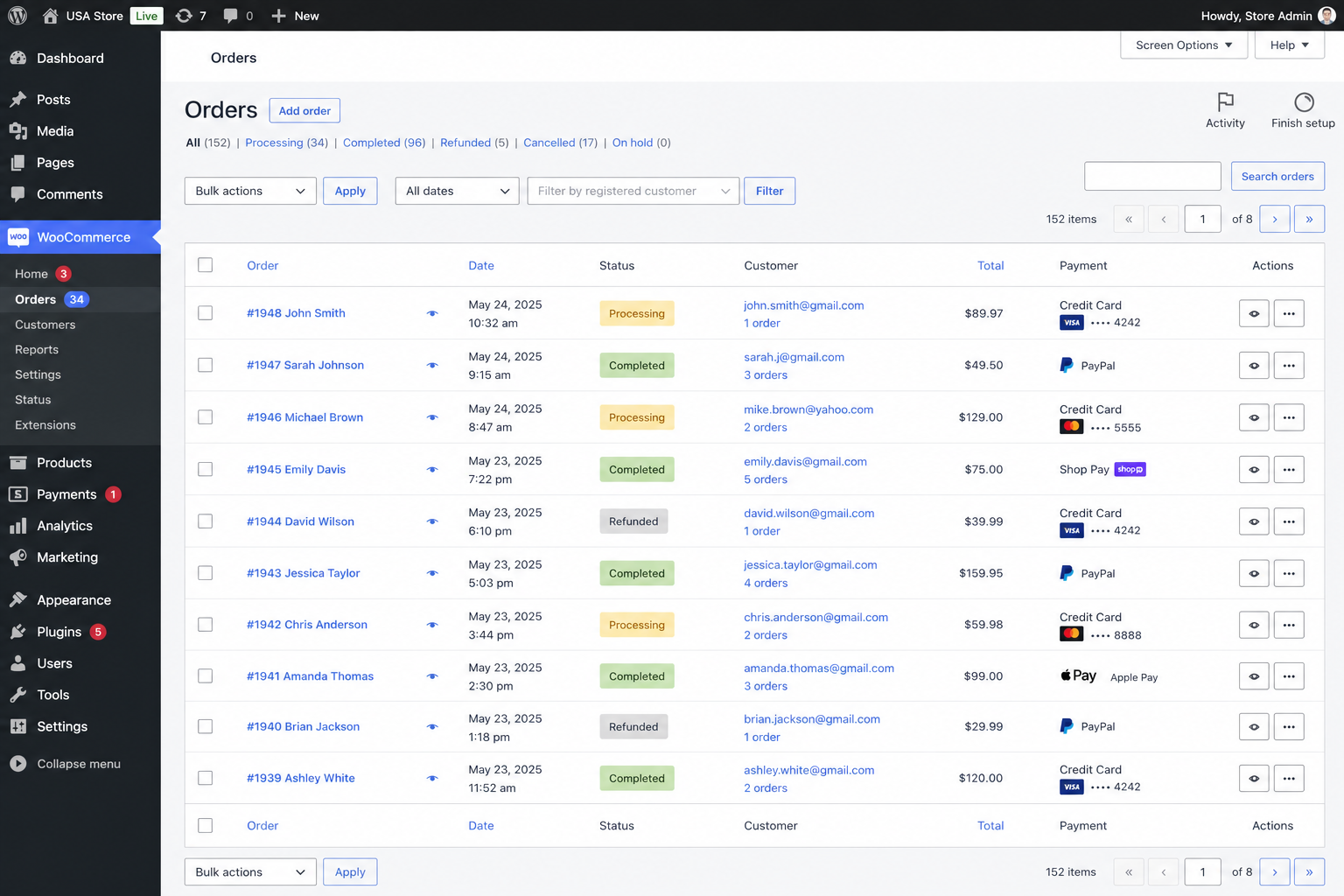
Ease of use winner: Shopify — for DIY setup. WooCommerce wins once set up by a professional developer.
Shopify vs WooCommerce Payment Fees for USA Stores
Transaction fees are where the Shopify vs WooCommerce cost difference becomes most painful for growing USA small businesses. Here is the exact fee breakdown:
Shopify transaction fees for USA businesses
- Shopify Payments (Stripe-powered) — 2.9% + $0.30 on Basic, 2.6% + $0.30 on Shopify plan, 2.4% + $0.30 on Advanced. Only available for businesses in certain countries including USA.
- Third-party gateway fee — if you use Stripe directly instead of Shopify Payments, Shopify charges an additional 2% (Basic), 1% (Shopify), or 0.5% (Advanced) on top of Stripe’s rate. This is the most expensive hidden cost in the Shopify ecosystem.
- PayPal — requires Shopify Payments to be active in the USA to use PayPal at standard rates. Otherwise a third-party fee applies.
WooCommerce payment fees for USA businesses
- Stripe for WooCommerce (free plugin) — 2.9% + $0.30 per transaction. No additional platform fee. Accepts all US cards, Apple Pay, Google Pay, and Afterpay.
- PayPal for WooCommerce (free plugin) — standard PayPal business rates. No platform surcharge.
- Any gateway — WooCommerce works with 100+ payment gateways with zero platform transaction fees on top of the gateway’s own rate.
On Shopify Basic using a third-party gateway, you pay Stripe’s 2.9% + $0.30 PLUS Shopify’s additional 2% fee = 4.9% + $0.30 per transaction. On a $100 order, that is $5.20 vs WooCommerce’s $3.20. On $10,000/month in revenue, that extra 2% costs $2,400/year extra — more than the entire cost of a WooCommerce store build from CodePulse Studios.
Payments winner: WooCommerce — zero platform transaction fees and full gateway freedom for USA businesses.
Shopify vs WooCommerce Design and Customization for USA Stores
Both platforms offer attractive storefronts, but the depth of customization differs significantly for USA small business owners who want a unique brand.
Shopify offers around 100 themes (13 free, 80+ paid at $180–$350). They are polished and mobile-optimized out of the box. However, customization is limited to what the theme allows — you cannot fundamentally change layout or add features outside the theme’s structure without significant Liquid (Shopify’s template language) coding knowledge.
WooCommerce, combined with the Blocksy theme and the Gutenberg block editor, gives you complete design freedom — custom page layouts, unique product page designs, animations, and any feature you can imagine. The free Blocksy theme is what CodePulse Studios uses on all WooCommerce client stores for USA businesses, and it rivals paid themes in quality and flexibility. Read how we use it in our custom website design service.
Design winner: WooCommerce — for full creative freedom. Shopify wins for quick, polished out-of-box results without developer help.
Shopify vs WooCommerce Ownership — Who Controls Your USA Store
This is the factor most USA small business owners overlook — and the one that matters most long-term when comparing Shopify vs WooCommerce.
With Shopify, your store lives on Shopify’s servers. If Shopify changes their pricing (they have done this multiple times), discontinues a feature, or decides to terminate your account for any reason, you have limited recourse. You can export your products as a CSV file — but not a complete, working, portable website. You are renting your store, not owning it.
With WooCommerce, every file, every database record, every pixel of your store is yours. You can download a complete backup and move to any hosting provider in the world at any time. No one can take it away from you, raise your rent, or change the rules. Full ownership, full portability, full control — permanently.
In 2023, Shopify increased their prices by 33% for existing merchants with minimal notice. Merchants on long-term plans had limited options — absorb the increase or undertake a costly migration. WooCommerce users faced zero price changes because WooCommerce software is free and open-source. This is the real cost of platform dependency for USA small businesses.
Ownership winner: WooCommerce — outright. No contest.
Shopify vs WooCommerce — Product Types for USA Online Stores
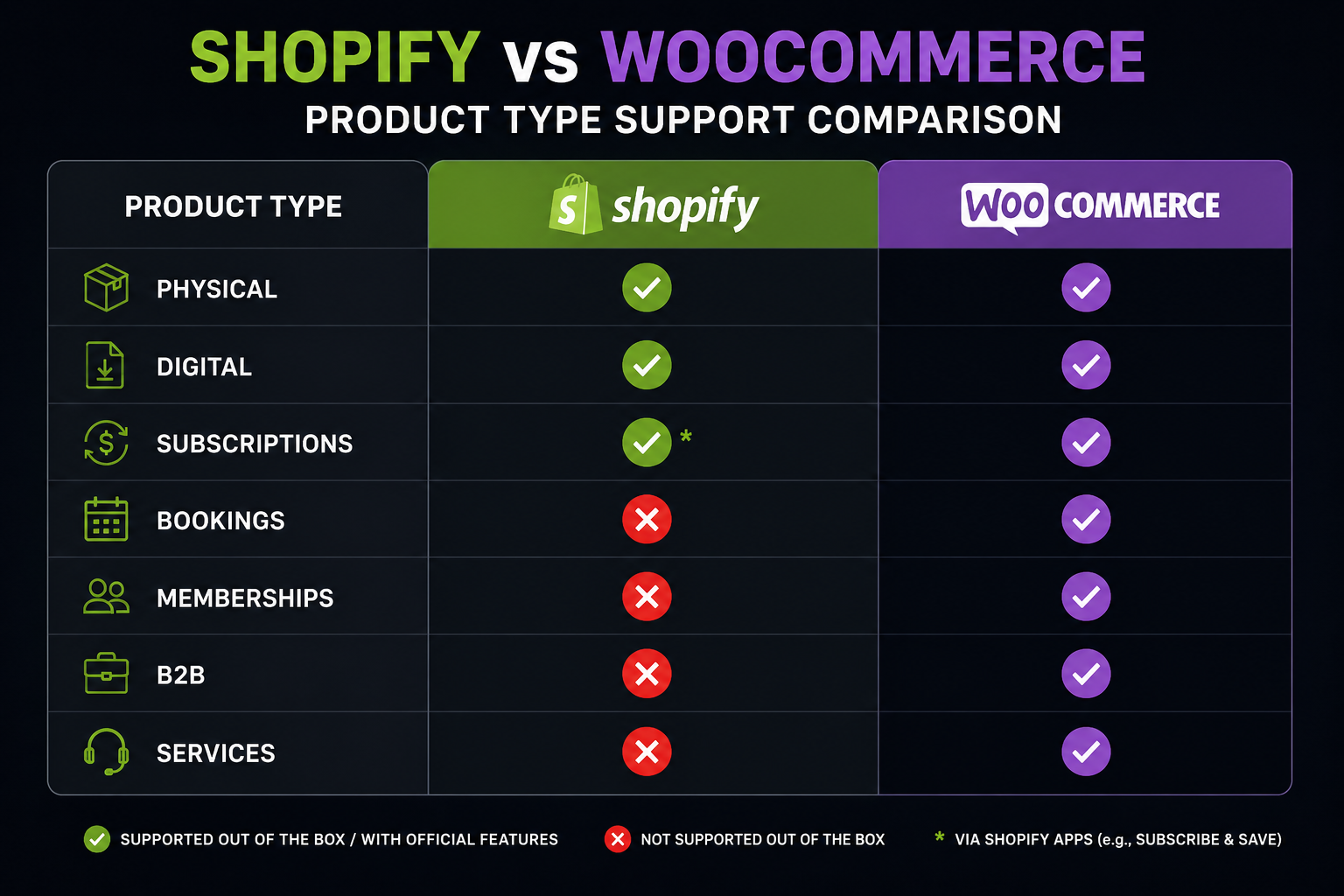
Both platforms handle physical products well. The Shopify vs WooCommerce difference becomes significant when US businesses need to sell beyond simple physical products:
- Physical products — both handle excellently. Variants, SKUs, inventory, and shipping all work well on both platforms.
- Digital downloads — both support digital products natively. WooCommerce gives more control over download limits, file security, and license keys.
- Subscriptions — Shopify requires the Recharge app ($99–$499/month). WooCommerce uses WooCommerce Subscriptions ($199/year one-time). WooCommerce is significantly cheaper for subscription businesses.
- Bookings and appointments — Shopify has no native booking system and requires third-party apps ($30–$100/month). WooCommerce Bookings ($249/year) is a robust built-in solution.
- Memberships — Shopify requires third-party apps. WooCommerce Memberships ($199/year) works natively with subscriptions and content restriction.
- B2B / wholesale — WooCommerce handles B2B pricing tiers, customer-specific catalogs, and purchase order workflows natively or with affordable plugins. Shopify Plus ($2,000+/month) is required for proper B2B on Shopify.
Product types winner: WooCommerce — more flexibility, lower cost for non-standard product types used by USA small businesses.
Full Shopify vs WooCommerce Comparison Table — USA Small Business 2026
| Feature | WooCommerce | Shopify |
|---|---|---|
| Platform fee | Free forever | $29–$299/month |
| Annual platform cost | $0 | $348–$3,588/yr |
| Hosting | $35–$120/yr (your choice) | Included (Shopify servers) |
| Transaction fee | 0% extra (pay gateway only) | 0.5%–2% if not Shopify Payments |
| You own 100% | Yes — always | No — hosted by Shopify |
| SEO control | Full — via RankMath | Limited |
| Schema markup | Full product + review schema | Basic (apps for more) |
| URL structure | Fully customizable | Forced /products/ prefix |
| PageSpeed control | Full via WP Rocket | Partial — theme dependent |
| Ease of setup (DIY) | Moderate — learning curve | Very easy |
| 24/7 support | Community + paid options | Yes — live chat |
| Design freedom | Unlimited — custom possible | Limited to theme structure |
| Free themes | 1,000s (Blocksy, Astra etc.) | 13 free themes |
| Subscriptions | $199/yr (WooCommerce plugin) | $99–$499/mo (Recharge app) |
| Bookings | $249/yr (WooCommerce plugin) | $30–$100/mo (third-party apps) |
| B2B / wholesale | Affordable plugins available | Requires Shopify Plus ($2k+/mo) |
| Blog / content SEO | World-class (WordPress) | Basic blog only |
| Plugin / app ecosystem | 59,000+ WordPress plugins | 8,000+ Shopify apps |
| Data portability | Full — move anywhere anytime | Limited CSV export only |
Who Should Choose Shopify vs WooCommerce as a USA Small Business
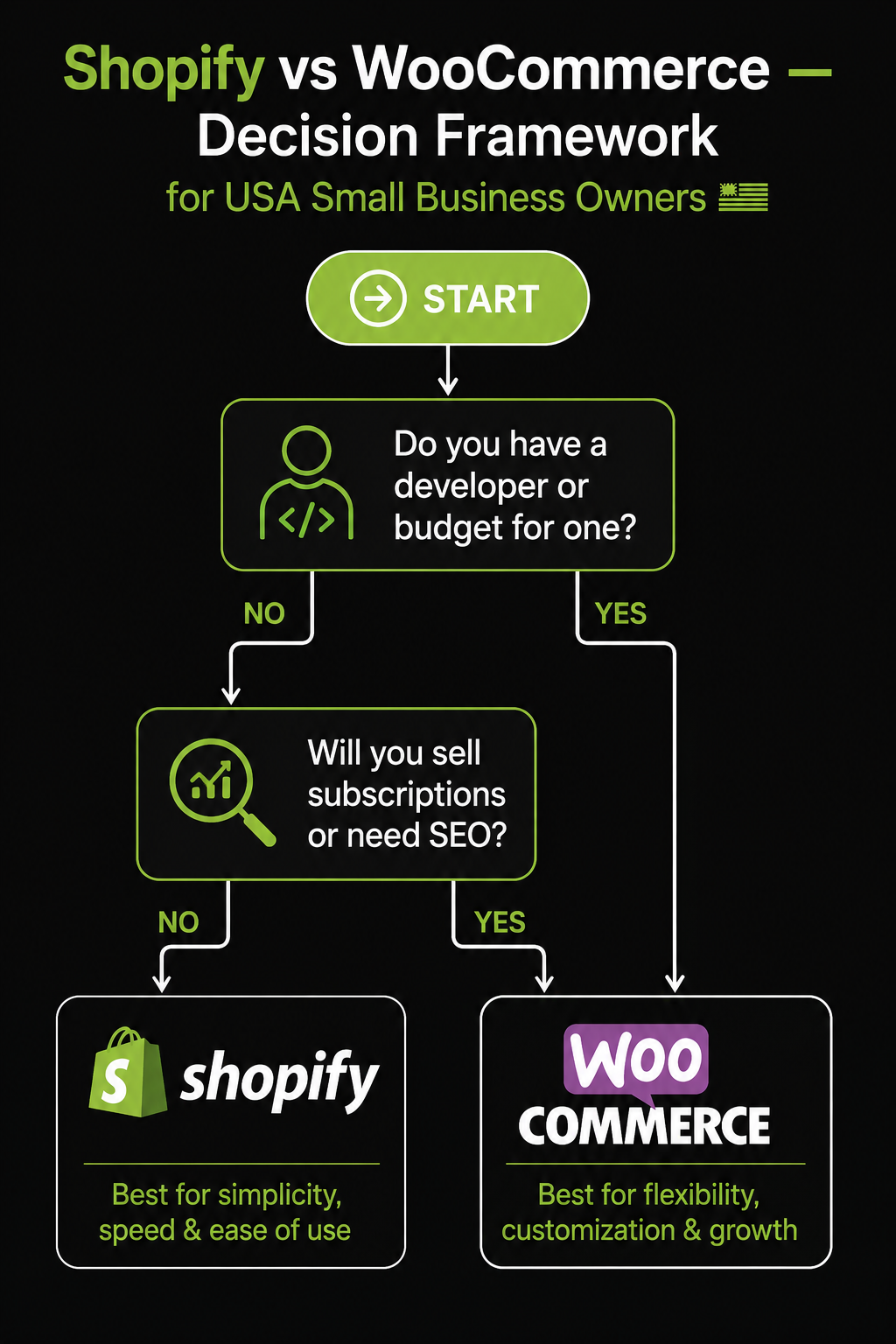
Choose WooCommerce if you are a USA small business that:
- Wants to minimize long-term platform costs and not pay monthly fees forever
- Cares about ranking on Google and wants full SEO control
- Plans to sell subscriptions, digital products, bookings, or B2B
- Wants to own the store outright — not be dependent on a platform
- Already has a WordPress website and wants to add ecommerce
- Is hiring a developer to build and set up the store (professional setup removes the ease-of-use disadvantage)
- Wants a fully custom design unique to their brand
Choose Shopify if you are a complete beginner who will 100% manage the store yourself with no developer help, you sell only straightforward physical products, you value 24/7 customer support above all else, and you are willing to pay $348–$1,000/year in platform fees for the convenience. Shopify is genuinely excellent for this use case — it is just more expensive and less powerful than WooCommerce for everything else.
For most USA small businesses — especially those working with a development agency like CodePulse Studios — WooCommerce is the right platform in 2026. Our WooCommerce ecommerce packages for USA businesses start at $499 one-time — which is less than 18 months of Shopify Basic fees — and include everything: custom design, payment setup, US shipping, sales tax configuration, SEO, and full training.
If you are currently on Shopify and want to switch to WooCommerce, we handle the full migration — products, customer data, order history, and redirects to preserve your Google rankings. See our guide on how to start an online store in USA with WooCommerce for the full setup process.
Want a WooCommerce Store Built for Your USA Business?
CodePulse Studios builds fully custom WooCommerce stores for USA small businesses — payments, shipping, tax, SEO, and products included. Starting at $499, delivered in 14 days.
→ View Ecommerce PackagesFrequently Asked Questions — Shopify vs WooCommerce for USA Small Business
Is Shopify or WooCommerce better for USA small businesses in 2026? +
How much does Shopify cost per year compared to WooCommerce for a USA small business? +
Can I switch from Shopify to WooCommerce without losing my data? +
Does WooCommerce or Shopify have better payment options for USA businesses? +
Is WooCommerce good for selling digital products and subscriptions in the USA? +
Which platform is better for local SEO for USA stores — Shopify or WooCommerce? +
Final Verdict — Shopify vs WooCommerce for USA Small Business in 2026
After comparing every factor that matters to USA small businesses — pricing, SEO, payments, ownership, design, and product types — WooCommerce wins the Shopify vs WooCommerce comparison for most USA small businesses in 2026. It costs less, ranks better on Google, charges no platform transaction fees, and gives you complete ownership of everything you build.
Shopify is not a bad platform — it is genuinely excellent for beginners who want to set up a simple physical product store themselves with no developer help. But for USA small businesses that care about long-term profitability, Google rankings, and not paying a growing monthly platform fee forever, WooCommerce is the smarter investment.
According to Statista, US ecommerce is growing toward $1.6 trillion by 2028. The USA businesses that build on WooCommerce now — with proper SEO, fast hosting, and professional setup — will be positioned to capture a growing share of that market without paying an ever-increasing platform fee for the privilege.
If you are ready to start or migrate to WooCommerce, contact CodePulse Studios for a free quote. We will have your WooCommerce store live and taking orders in 14 days.